

About Wren day
While many people are relaxing on the day after Christmas, munching on leftovers and enjoying new gifts, parts of Ireland are bursting into song and colour with one of the country's oldest and most unique traditions.
December 26th, known variously as St. Stephen's Day or Boxing Day in other parts of the world, is celebrated in Ireland as Wren Day, or Lá an Dreoilín in Irish.
This ancient festival centres around one of Ireland's smallest birds, the wren, and involves music, dancing, and very distinct costumes. It’s a fantastic example of living folklore that brings communities together during the depths of winter.
What is Wren Day?
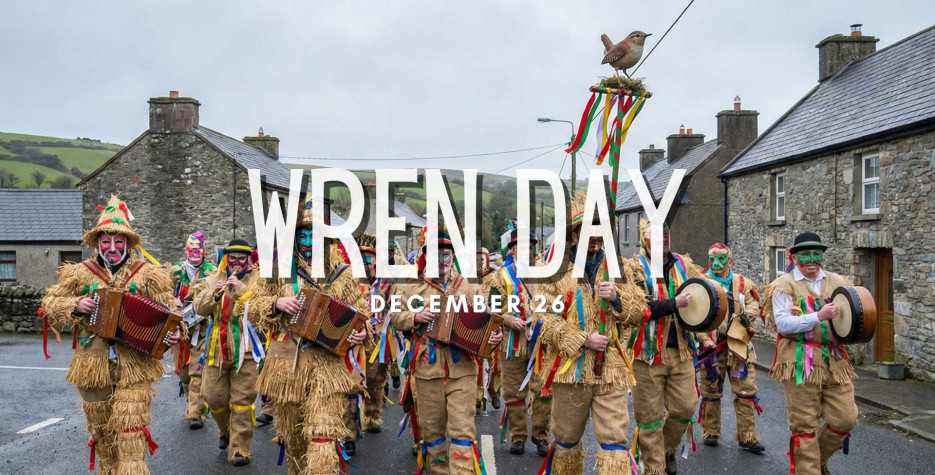
Wren Day is a traditional celebration where groups of people, known as "Wrenboys" (though today both men and women participate), dress up in elaborate disguises and parade through towns and villages. The costumes are striking, often made almost entirely of straw, topped with colourful masks, ribbons, and old clothes. The goal is to disguise your identity completely.
These groups travel from house to house or pub to pub, playing traditional Irish music with accordions, bodhráns, and tin whistles. They sing the traditional "Wren Song," begging for contributions—which, in modern times, usually go to local charities. The song famously begins with the lines:
"The wren, the wren, the king of all birds, / On St. Stephen's Day was caught in the furze..."
Historically, the tradition involved hunting a real wren and parading the deceased bird on top of a decorated holly bush or pole. Fortunately, this aspect of the tradition has largely died out. Today, the "wren" carried on the pole is almost always a fake bird or an effigy, allowing the celebration to continue without harming wildlife.
Did you know? According to Irish folklore, the tiny wren became the "King of All Birds" by winning a flying contest. It hid in the feathers of an eagle, and when the eagle became tired and couldn't fly any higher, the fresh little wren flew out and soared above it.
The Legends Behind the "King of All Birds"
Why is such a tiny bird the centre of so much attention? The origins of Wren Day are murky, likely pre-dating Christianity and tied to mid-winter pagan festivals celebrating the returning light. However, Irish folklore offers several explanations for why the wren was traditionally hunted on this day.
The most common legends paint the wren as a traitor. One story claims that during Viking raids in the 700s, Irish soldiers were sneaking up on a Viking camp.
A wren landed on a Viking drum and started pecking at crumbs, creating enough noise to wake the sleeping sentries and foil the Irish attack.
Another legend links the bird to St. Stephen, the first Christian martyr. It is said that St. Stephen was hiding from his persecutors, but his location was given away by a chattering wren, leading to his capture and death on December 26th. Therefore, hunting the bird was seen as punishment for its past betrayals.
How to Celebrate Wren Day Today
If you aren't in Ireland, you can still embrace the spirit of Wren Day. It is a day focused on community, music, and heritage.
Listen to Traditional Music: Spend the day listening to traditional Irish folk music, especially tracks that feature the bodhrán (an Irish frame drum) and fiddle, to get into the festive spirit.
Donate to Charity: In the spirit of the modern Wrenboys collecting money for good causes, make a donation to a local charity in your area today.
Visit Dingle: If you ever have the chance to travel for the holidays, the town of Dingle in County Kerry is famously the heart of modern Wren Day celebrations. The town hosts huge, competitive parades of rival "wren" groups, making for an unforgettable spectacle starting at 6 a.m.!
Did you know? In the town of Dingle, the celebration is taken very seriously. Different parts of the town have rival "Wren" groups, such as the Green and Gold Wren or the Sráid Eoin Wren, that compete to be the best group of the day.
Whether you are in County Kerry or halfway across the world, December 26th is a great day to appreciate the enduring nature of folk traditions and the strange, wonderful stories that shape cultures.
Similar Observances


Nollaig na mBan
Read More
Other Observances on December 26th 2026
Boxing Day 🎁
Read More

National Candy Cane Day
Read More

National Whiner’s Day
Read More